Cold exposure
Cold Showers in Winter: Is It Safe, and How to Actually Do It
Somewhere around late November, the same question shows up in every cold-shower forum: "Do I still have to do this now that it's actually cold outside?" One regular on r/coldshowers answered it better than most: "The water doesn't know what season it is. You do. That's the whole problem."
That's the honest version of what changes in winter. The physics of cold water on skin is identical in July and January. What changes is you — the bathroom is colder, the towel is colder, the walk from the shower to your clothes is colder, and every excuse you've built all year suddenly has backup. This is the straight answer on whether cold showers in winter are safe, what actually happens to your body when you take one in the cold months, and how to keep the habit without hurting yourself or hating your mornings.

What actually changes in winter
Three things shift when the seasons turn, and only one of them is physical. First, tap water genuinely gets colder — in most temperate climates, groundwater temperature tracks the season, so winter tap water can run roughly 15-25°F (8-14°C) colder than summer tap water straight out of the pipe. Second, the air around you gets colder too, so you're not just facing cold water, you're facing a cold room before and after it. Third, and this is the one people underestimate, your baseline tolerance often drops because you're simply exposed to less discomfort overall in winter — more time indoors, more layers, more heating. The cold shower stops being one data point among many small exposures and becomes the only one.
None of that makes the practice more dangerous. It makes it feel harder, which is a different thing, and worth separating clearly before you decide whether to keep going or back off.
There is also a quieter shift worth naming: motivation. In summer, a cold shower is often a relief — it undoes the heat of the day, it feels like the obvious choice. In winter, it works against the grain of everything else you want, which is warmth, blankets, and staying under hot water two minutes longer than you need to. That reversal is why so many people who kept the habit easily from May through September suddenly find themselves negotiating with it in December. The practice hasn't changed. The resistance to it has grown, and it grows precisely because the rest of your environment is now pulling in the opposite direction.
Is it safe
For a healthy adult, a cold shower in winter carries the same risk profile as a cold shower in summer: low, with a short list of real exceptions. The water is colder by a matter of degrees, not by an order of magnitude — you're not stepping into an ice bath, you're stepping into tap water that happens to be sharper this time of year.
The people who should be genuinely cautious are the same people who should be cautious year-round: a history of heart disease or very high blood pressure, Raynaud's phenomenon, pregnancy, or any condition where a sudden spike in heart rate and blood pressure is a real concern. Cold water triggers a fast sympathetic response — heart rate and blood pressure both jump in the first seconds — and that response doesn't care what month it is.
It is also worth separating "colder water" from "colder conditions" in general. Standing outside in winter without a coat is a genuinely different risk than a ninety-second cold shower in a heated bathroom. The exposure here is brief, controlled, and reversible the moment you step out and reach for a towel — which is a very different category from prolonged outdoor cold, wet clothing, or wind chill. Conflating the two is a common reason people either overestimate the danger of a winter cold shower or underestimate the danger of actual winter weather.
What the cold does to your body
The first ten seconds are the hardest part, and that's not an accident of psychology — it's the cold shock response: a sharp gasp, a spike in breathing rate, and a jump in heart rate as your nervous system reacts to the sudden temperature drop on your skin. It peaks fast and fades faster. Most people find the first 10-15 seconds are the worst of the entire shower, and everything after that is genuinely easier.
Underneath that initial shock, your extremities are running their own quiet routine. Fingers and toes exposed to sustained cold don't just lose heat in one direction — they cycle through a pattern called cold-induced vasodilation, sometimes nicknamed the "hunting reaction," where blood vessels in the fingers alternately constrict to conserve heat and then briefly dilate to flush warm blood back through, protecting the tissue from frostbite-level cold. It's the reason your fingers can go from aching to briefly warm and back again during a longer cold exposure — your body running its own protective loop in the background while your conscious mind is busy deciding whether to stay in.
There is a second, slower layer to the response that matters more in winter than people expect. After the initial gasp fades, your body begins shifting blood flow away from the skin's surface and toward the core, a process called vasoconstriction. It is the same mechanism that makes your hands look pale after a few minutes in cold water. In a controlled shower this is harmless and reversible — the moment you step out into a warm room, blood flow returns to the skin and the pale look fades within a minute or two. It only becomes a genuine concern when the cold exposure is prolonged and the room afterward is also cold, which is exactly why the room-temperature step later in this piece is not a minor detail.
Does it help you avoid getting sick
Winter is exactly when the "does this boost immunity" question gets loudest, so it's worth being precise about what the evidence actually shows. A 2016 randomized controlled trial published in PLOS ONE put over 3,000 adults into groups that finished their normal warm showers with 30, 60, or 90 seconds of cold water, versus a warm-shower-only control group, for 30 days. The cold-finish groups reported roughly 29% fewer self-reported sick-day absences from work over the following months than the control group.
Hot-to-cold showering leads to a decrease in sickness absence from work.
That's a real, published result — and it's worth being honest about its limits too. The measure was self-reported sick days, not confirmed infection rates, and the effect showed up regardless of how long the cold portion lasted, which suggests the mechanism might be about general resilience or behavior change more than a specific immune boost from the cold itself. It's a reasonable, sourced "this probably helps a little," not a guarantee against the winter cold going around your office.
One detail from that trial is easy to miss and worth calling out: the dose-response relationship was flat. Ninety seconds of cold water didn't outperform thirty seconds. That flatness is a useful piece of evidence on its own — it argues against the idea that more suffering equals more benefit, and it supports the more modest, sustainable approach this article recommends for winter: short, consistent exposure beats long, punishing exposure that you eventually stop doing altogether.
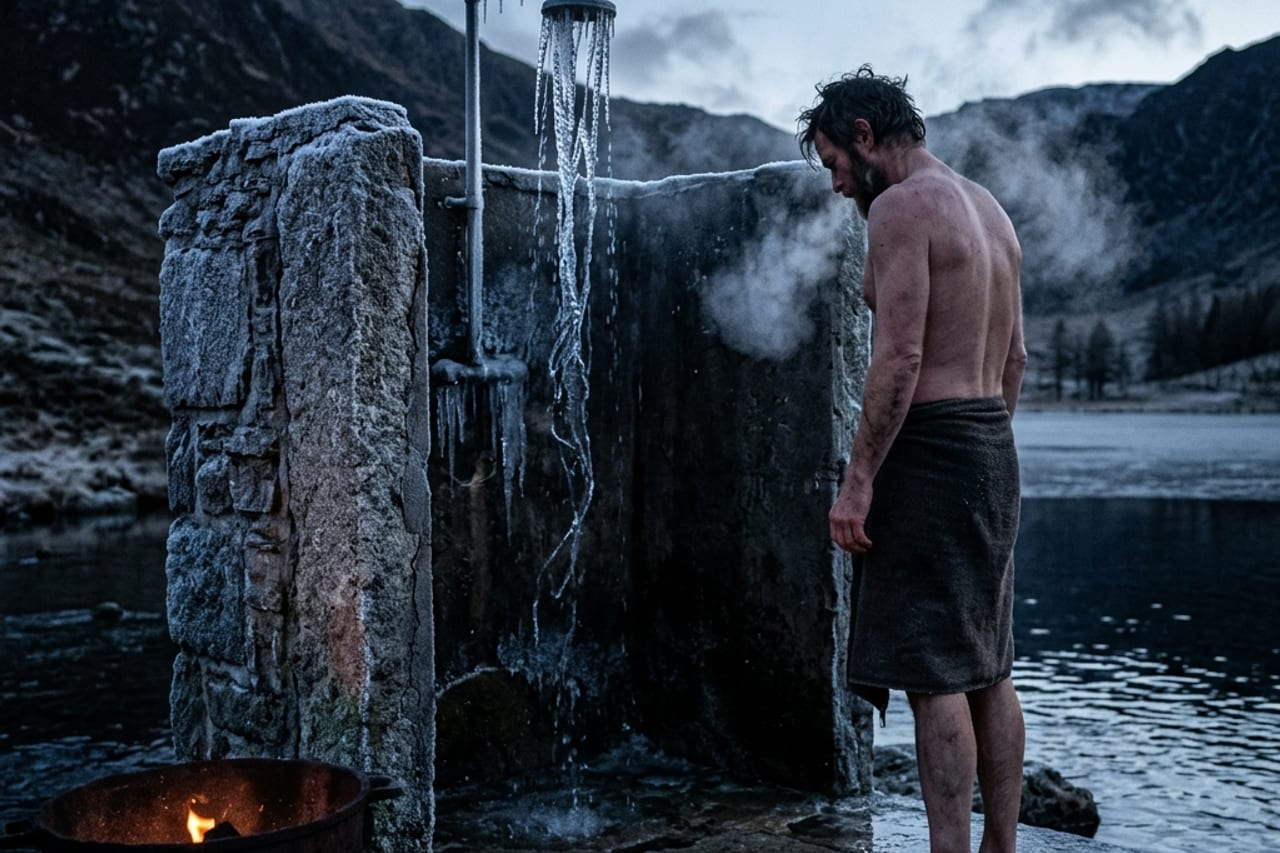
The skin question
Winter is also when everyone's skin gets drier, and cold showers get blamed by association. The actual dermatological guidance points the finger somewhere else: hot water, not cold, is the bigger offender. Dermatologists commonly note that hot water strips the skin's natural oil barrier faster than cool or cold water does, which is exactly why long hot showers are one of the most common, avoidable causes of winter itch and flaking.
A short cold finish doesn't add to that problem — if anything, cutting the hot-water portion shorter and closing with cold likely helps more than it hurts. The habit worth reconsidering in winter isn't the cold at the end. It's the ten-minute scalding shower some people run beforehand to "earn" the cold finish, which is doing more damage to your skin than the cold ever will.
A simple moisturizing step also does more for winter skin than any change to your shower routine. A thin layer of an unscented, fragrance-free moisturizer applied within a couple of minutes of stepping out, while skin is still slightly damp, traps far more moisture than applying it to fully dry skin later. That single habit, paired with a shorter hot-water portion, addresses most of what people actually mean when they say winter showers are drying them out.
How to actually do it this season
The mechanics don't need to change much from any other time of year — you just have to account for the colder room around the water.
- Warm the bathroom first.Run the fan off, close the door, let a hot shower's steam build the room up for a minute before you even think about the cold finish. You're not cheating — you're removing a variable that has nothing to do with the actual practice.
- Keep the towel and clothes within arm's reach. In summer, dripping across the bathroom for thirty seconds is a non-event. In winter, that same thirty seconds in a cold room is often harder than the shower itself. Fix the logistics, not your tolerance.
- Shorten the exposure before you drop the temperature.If tap water is already colder this month, you don't need to add ice or crank the dial further. Match your winter time to how sharp the water already feels — often that means a shorter finish than your summer routine, not a longer one.
- Move immediately afterward. A minute of brisk movement — toweling off fast, getting dressed, doing a few jumping jacks — brings your temperature back up faster than standing still in a cold bathroom deciding how you feel about your choices.
- Keep the streak visible.Winter is exactly when habits quietly die, one skipped day at a time. Track it somewhere you'll actually see, so the missed morning is a decision, not an accident.
A practical breathing note belongs here too. The cold shock response tends to hijack your breathing before it hijacks your resolve — the gasp turns into short, high, panicky breaths that make the whole thing feel worse than it is. A slow, deliberate exhale, longer than the inhale, is the fastest way to pull your nervous system out of that spiral. It doesn't remove the discomfort. It keeps you functional inside it, which is the entire skill this practice is actually training.
When to skip it or scale it back
There's a difference between winter making a cold shower feel harder and winter making it a bad idea. Skip or scale back the cold portion if you're already fighting an active cold or fever — your body is managing enough right now without an added sympathetic spike. Skip it if the bathroom itself is genuinely unheated and cold enough that you'd be shivering hard before you even touch the water. And skip it, permanently or with a doctor's sign-off, if you fall into any of the caution categories above: cardiovascular conditions, uncontrolled high blood pressure, Raynaud's, or pregnancy.
Outside of those, the more common failure mode in winter isn't medical, it's motivational — and the fix for that isn't forcing through colder water, it's avoiding the same beginner mistakes that sink the habit in any season: starting too extreme, skipping the warm-up mentally, and treating one missed day as a reason to quit rather than a reason to restart smaller tomorrow.
It also helps to distinguish discomfort you should push through from discomfort that's telling you something. Racing heartbeat that doesn't settle within a minute of getting out, numbness that lingers well past the shower, or genuine dizziness are signals to stop and reassess, not signals to grit your teeth harder. The goal was never heroics under the water. It was a brief, honest encounter with discomfort that you walk away from clear-headed and slightly steadier than before you stepped in.
Keeping the habit through the cold months
Seneca didn't wait for winter to arrive before practicing hardship — he scheduled it deliberately, on days he chose, precisely so the real cold, when it came uninvited, would have less power over him. That's worth remembering here. Winter cold showers aren't a harder version of the same test. They're the same small rehearsal, run in slightly rougher conditions, which is exactly what makes them useful.
The point was never to prove you can stand freezing water in January. It's to notice, each time you step out, that the discomfort you braced for was survivable again — and that you did the thing you said you'd do, on a morning when it would have been easy not to. If you want a structured way to calibrate the exposure to your actual level instead of guessing, the Discomfort Challenge Generatorwill pick one for you and track the streak. Otherwise: warm the room, keep it short, get dressed fast, and show up tomorrow. That's the whole winter version of the practice.
Most people who quit a cold-shower habit in winter don't quit because the water is too cold. They quit because they let one skipped morning become two, then a week, and by the time they notice, restarting feels like starting over from nothing. The counter to that is almost embarrassingly simple: make the next exposure smaller than the one you skipped, not bigger. A fifteen-second cold finish you actually do beats a ninety-second one you keep postponing. Consistency, not intensity, is the entire game through the cold months — and it's the one variable that's fully within your control regardless of what the thermometer outside says.
Sources
- [1]Seneca, Letters to Lucilius, Letter 18 ('On Festivals and Fasting') — Seneca's practice of deliberately living as if poor for a set number of days, then asking himself whether the hardship he feared was actually survivable.
- [2]Epictetus, Enchiridion, ch. 1 (MIT Classics) — The dichotomy of control — the frame for treating discomfort as something to meet on purpose rather than avoid on reflex.
- [3]Buijze et al. (2016), 'The Effect of Cold Showering on Health and Work', PLOS ONE — Randomized trial; groups finishing showers with cold water self-reported roughly 29% fewer sick-day absences over 30 days than a warm-shower control group.
- [4]Daanen, H.A.M. (2003), 'Finger cold-induced vasodilation: a review', European Journal of Applied Physiology — Review of the 'hunting reaction' — the cyclical vasodilation that rewarms fingers and toes during sustained cold exposure.
- [5]American Academy of Dermatology, 'Dry, itchy skin: How to find relief' — Dermatologist guidance that hot water, more than cold, strips the skin's protective oils and worsens winter dryness.
Make it daily
Keep the streak where you'll see it
Reading about discomfort changes nothing. Doing one hard thing a day, every day, is what rebuilds self-trust. StoicNow puts your challenge and your streak on your lock screen — so you can't quietly skip it.
Founding members get 3 months of Premium free. Launching 2026.
Questions people actually ask
Are cold showers safe in winter?+
For most healthy adults, yes. Winter doesn't change the physiology of a cold shower in any dangerous way — the water simply starts colder, so the same routine feels sharper. The people who need to be careful are the same people who need to be careful year-round: those with heart conditions, uncontrolled high blood pressure, Raynaud's, or who are pregnant. For everyone else, the main risk is quitting too fast, not injury.
Do cold showers in winter help you avoid getting sick?+
The best evidence is a 2016 randomized trial where people finishing showers with 30-90 seconds of cold water reported about 29% fewer sick-day absences than a warm-shower control group. That's a meaningful signal, not proof — the study measured self-reported sick days, not lab-confirmed infections. Treat it as 'promising,' not 'guaranteed immunity.'
How cold should the water be for a winter cold shower?+
Cold enough to make you want to get out — that's the real gauge, not a number. Winter tap water already runs 15-25°F (8-14°C) colder than summer tap water in most climates, so you may not need to touch the dial at all. Start with whatever comes out of the pipe and finish there before you chase colder.
Will cold showers dry out my skin more in winter?+
Less than hot showers will. Dermatologists consistently flag hot water, not cold, as the bigger driver of winter dry skin, because heat strips the skin's protective oil layer faster. A short cold finish is generally gentler on skin than a long hot soak — the habit to watch is the hot water before it, not the cold after it.
Is it harder to keep a cold shower habit in winter?+
Yes, mostly for psychological reasons. The whole bathroom is colder, the water feels more aggressive on first contact, and the appeal of staying under hot water is stronger. The fix isn't toughing out more cold — it's shortening the exposure, keeping the room warm, and rebuilding the habit at a slightly easier level until it's automatic again.
Written by
Marcus HaleWriter & Stoic-practice researcher
“I'm not a doctor or a psychologist. I'm someone who has practiced this daily for years and reads the Stoics closely. Where health is involved, I cite the research and tell you to talk to a professional.”
Keep reading
The field notes
One honest practice, most weeks
No hype, no streak-shaming. Occasional letters on doing voluntary discomfort without wrecking yourself.