The how-to
How to Take an Ice Bath at Home Without Hurting Yourself
The first ice bath almost never goes the way people imagine. They picture a calm, monk-like soak. What actually happens is a sharp involuntary gasp, a chest that won't fill, and a loud animal voice in the head saying get out, get out, get out. That gasp is not weakness. It's a reflex called the cold-shock response, and understanding it is the difference between a safe practice and a genuinely dangerous one.

This is the plain, practical guide to how to take an ice bath at home: what gear you need, how cold the water should be, how long to stay in, and the safety facts that the motivational clips skip. I'm a practitioner, not a doctor, and where health is on the line I'll point you to a real source and tell you to ask a professional. The goal here is the Stoic one — to meet a hard thing on your own terms and come out steadier — not to win a comment-section contest over who can sit in colder water.
The short answer
If you read nothing else: fill a tub with cold water, add ice until it's around 10–15°C (50–59°F), get in slowly with your chest and hands out at first, breathe slowly and on purpose, and stay 2–5 minutes. Get out, dry off, and rewarm with movement and dry clothes — not a scalding shower. That's the whole thing. Everything below is just doing each of those steps without hurting yourself.
What you actually need
You don't need a $5,000 chiller to start. You need a container, cold water, ice, and a way to measure the temperature. Here's the honest kit list.
- A vessel. A normal bathtub works. No tub? A large stock tank, a sturdy storage tote (around 100 litres), or an inflatable plunge tub all do the job. It needs to be deep enough to cover your legs and torso while you sit upright with your head well clear.
- Cold tap water. Fill it first. Your starting temperature decides how much ice you need — winter tap water is already near 10°C in many places and barely needs any.
- Ice. Plan on roughly 5–10 kg (10–20 lbs) to chill a tub of cold tap water into range. Bagged ice from a shop is cheapest at first; reusable frozen bottles work if you do this often.
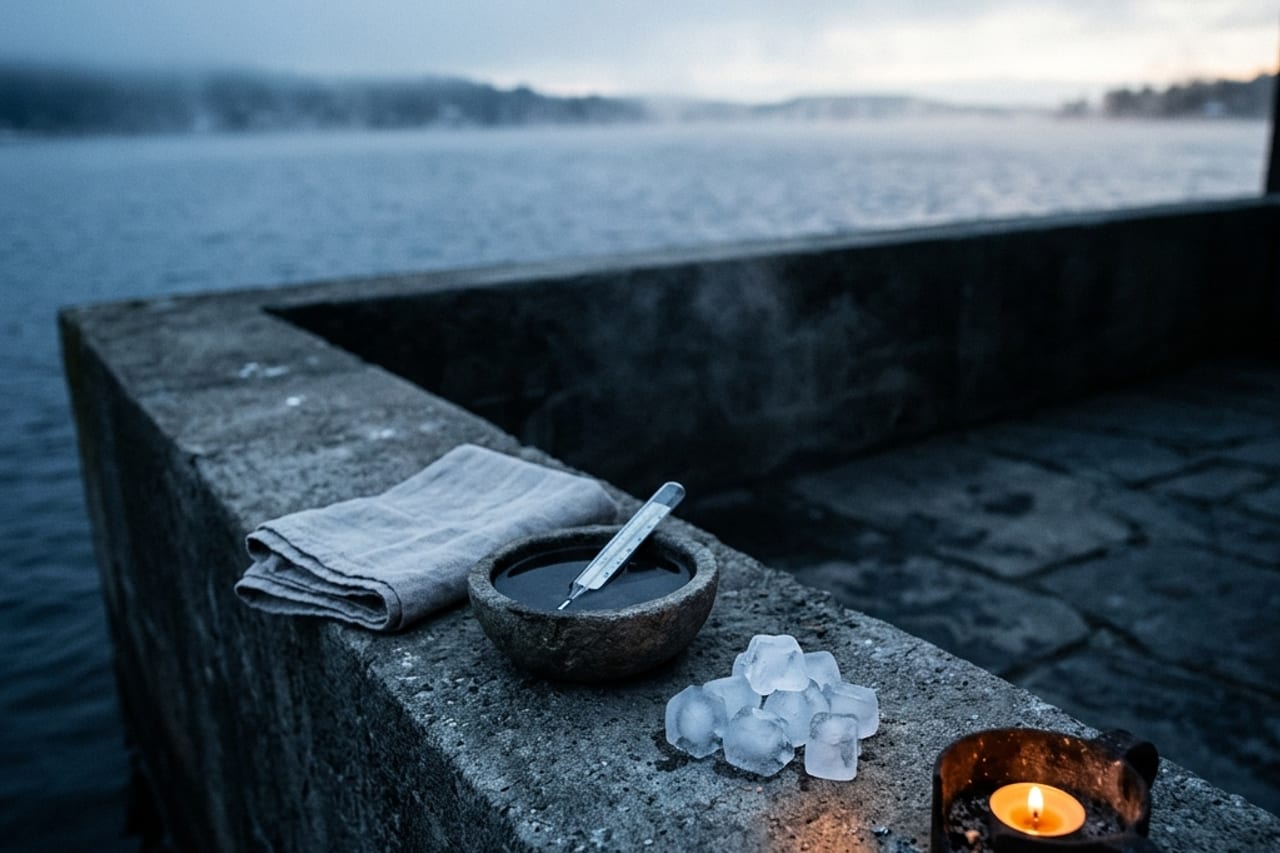
- A thermometer. A cheap floating pool or kitchen thermometer is the single most useful item here. Guessing the temperature is how people end up either uselessly lukewarm or dangerously cold.
- A towel, warm dry clothes, and a timer. Lay them out before you get in, while your hands still work properly. Cold makes fine motor control clumsy fast.
How cold, and how long
This is where most of the bad advice lives, so let's be specific. For a home ice bath, 10–15°C (50–59°F)is a sensible working range. It's cold enough to trigger the response you're training and feel genuinely hard, without tipping into the territory where the body starts treating it as a life-threatening emergency.
Time matters less than people think. Two to five minutesis plenty for a beginner, and there's no evidence that grinding out fifteen minutes buys you more. A 2022 review of voluntary cold-water exposure found that the research base, while real, is still limited and inconsistent — which means nobody can honestly promise you a precise dose-response curve. Start short, add time slowly over weeks, and stop chasing a number.
Step by step
Here is the actual sequence, in order, the way I'd walk a friend through their first one.
- Set up everything dry first. Timer ready, towel and warm clothes within reach, floor not slippery. Do this while your hands still work.
- Fill, ice, measure. Cold tap water, then ice, then check the thermometer. Adjust to 10–15°C. Wait a minute and re-check — ice keeps working after you add it.
- Get in slowly. Sit down in stages. Legs, then hips, then lower yourself so the water reaches your chest. Keep your hands out of the water for the first thirty seconds or so — the hands and face drive a lot of the shock.
- Control the first breath.The instant you're in, your body will want to gasp and pant. Don't fight it with bravado; manage it. Long, slow exhales. Get the breathing under control before you try to relax anything else. This is the whole skill.
- Be still and stay shallow. Once your breathing settles, stop wriggling. Keep your head and airway well above the surface the entire time. Watch the timer.
- Get out on purpose, not on panic. When your time is up — or earlier if something feels genuinely wrong — stand carefully and get out. Cold legs are wobbly. Hold something.
The cold-shock response (the real danger)
The thing that actually hurts people in cold water isn't the cold over time — it's the first ninety seconds. When skin hits cold water, the body fires a reflex: a sharp inhale, a jump in heart rate and blood pressure, and uncontrollable rapid breathing. Researchers who study cold-water immersion call this the cold-shock response, and they're blunt about why it matters.
Most cold-water deaths happen in the first minutes of immersion, driven by the shock of the cold — not by hypothermia, which takes far longer to set in.
Read that as the safety rule it is. In a deep tub, an involuntary gasp at the wrong moment can mean inhaling water. That's why every step above keeps your head and airway clear and why you never fully submergefor a home ice bath. The cold-shock response also fades with practice — it's strongest the first few times and habituates with repeated, sensible exposure. So the early sessions, when the reflex is loudest, are exactly when to be most conservative: shallower, shorter, someone nearby.
Getting out and the afterdrop
Here's the part the highlight reels never show: you can feel colder afteryou get out than you did in the water. As cold blood from your limbs circulates back toward your core once you start moving and rewarming, your core temperature can keep dropping for a while. It's called the afterdrop, and it's normal — but it means the few minutes after the bath deserve as much respect as the bath itself.
- Dry off immediately and get into warm, dry layers. Wet skin in cold air keeps pulling heat out of you.
- Rewarm with gentle movement — walking, light bodyweight movements, a warm drink. Your own muscle activity is a safe, steady heat source.
- Skip the scalding shower right away. Slamming very hot water onto cold skin is uncomfortable and can make you lightheaded. Let your body do most of the rewarming, then a warm (not hot) shower is fine.
- Don't drive or do anything risky until your hands, focus, and coordination are fully back. Give it fifteen or twenty minutes.
Mistakes people make
Almost every problem I see comes down to treating the ice bath as a test of toughness instead of a practice. The training-versus-punishment line is the same one that runs through all of voluntary discomfort: a real purpose, a sane dose, and a private aim of a steadier mind. Cross that line and the bath stops helping.
Doing it right
- Measured water, 10–15°C, checked
- 2–5 minutes, breathing under control
- Head and airway always clear
- Rewarms calmly afterward
- Stops the moment something feels wrong
Asking for trouble
- Dumps in all the ice, never measures
- Pushes for 15 minutes to prove a point
- Submerges the head, holds breath
- Films it, performs for the camera
- Ignores the gasp and "powers through"
The other quiet mistake is doing too much, too soon. If the ice bath sounds like a leap, it's often wiser to build the reflex first with cold showers and a gentler on-ramp, then graduate to the tub. There's no prize for skipping the easy version.
Who should not do this
Cold immersion is a real physiological stressor, and the shock to heart rate and blood pressure is not trivial. Some people should talk to a doctor before they start, and a few should simply skip it.
- Heart conditions or high blood pressure. The sudden spike in heart rate and blood pressure from cold-water immersion can be dangerous. Clear it with a doctor first.
- Pregnancy, Raynaud's, or circulation disorders. These change how your body handles cold. Get professional advice rather than guessing.
- Epilepsy or fainting tendencies near water are an obvious hazard — a loss of consciousness in a tub is a drowning risk.
- Anyone alone and inexperienced.For your first sessions, have someone in the home who knows what you're doing.
Done with care, the ice bath earns its place. Not because cold water is magic, and not because suffering is virtuous — but because choosing a hard thing, meeting it calmly, and getting out steadier is a rehearsal for everything else that's going to be cold and unchosen later. Borrow Seneca's line as you lower yourself in: is this the condition that I feared? Almost always, once your breathing settles, the answer is no. If you want the wider case for it, start with whether the bath is even worth it over a shower.
Sources
- [1]Tipton et al. (2017), 'Cold water immersion: kill or cure?', Experimental Physiology — On the cold-shock response, the gasp/hyperventilation reflex, and why the first minutes of immersion are the most dangerous.
- [2]Espeland, de Weerd & Mercer (2022), 'Health effects of voluntary exposure to cold water', International Journal of Circumpolar Health — A review concluding the evidence base for cold-water health benefits is real but still limited and inconsistent.
- [3]Buijze et al. (2016), 'The Effect of Cold Showering on Health and Work', PLOS ONE — Randomized trial; ~29% fewer self-reported sick-day absences in the cold-shower groups.
- [4]Seneca, Letters to Lucilius, Letter 18 ('On Festivals and Fasting') — Seneca's rehearsal of hardship: plain food, rough dress, 'Is this the condition that I feared?'
Make it daily
Keep the streak where you'll see it
Reading about discomfort changes nothing. Doing one hard thing a day, every day, is what rebuilds self-trust. StoicNow puts your challenge and your streak on your lock screen — so you can't quietly skip it.
Founding members get 3 months of Premium free. Launching 2026.
Questions people actually ask
How do you take an ice bath at home?+
Fill a tub or large container with cold water, add ice until it reaches roughly 10–15°C (50–59°F), and check it with a cheap thermometer. Get in slowly, keep your hands and chest out at first, breathe slowly, and stay 2–5 minutes. Get out, dry off, and rewarm gradually with movement and dry clothes.
How cold should an ice bath be, and how long should I stay in?+
For a home ice bath, 10–15°C (50–59°F) is a sensible range; colder is not better and raises the risk. Beginners should aim for 2–3 minutes, working up toward 5–10 over weeks. There is no proven benefit to staying longer, and the danger rises the more you push it.
Is it safe to take an ice bath at home alone?+
It can be, but the cold-shock response in the first 30–90 seconds is the real hazard — it triggers a gasp and rapid breathing that can lead to inhaling water in a deep tub. Keep your head and airway well clear of the water, never submerge fully, and ideally have someone nearby the first few times.
How much ice do I need for an ice bath?+
Roughly 5–10 kg (10–20 lbs) of ice will chill a standard bathtub of cold tap water into the 10–15°C range, depending on your starting water temperature. Add ice gradually and measure with a thermometer rather than guessing — tap water in winter may need far less.
Do ice baths actually have benefits, or is it hype?+
The honest answer is mixed. A 2016 randomized trial found people finishing showers with cold reported about 29% fewer sick-day absences, and many practitioners report a calmer, clearer head. But a 2022 review concluded the overall evidence on cold-water immersion is still limited and inconsistent. Treat the health claims as promising, not settled.
Written by
Marcus HaleWriter & Stoic-practice researcher
“I'm not a doctor or a psychologist. I'm someone who has practiced this daily for years and reads the Stoics closely. Where health is involved, I cite the research and tell you to talk to a professional.”
Keep reading
The field notes
One honest practice, most weeks
No hype, no streak-shaming. Occasional letters on doing voluntary discomfort without wrecking yourself.